

Overview
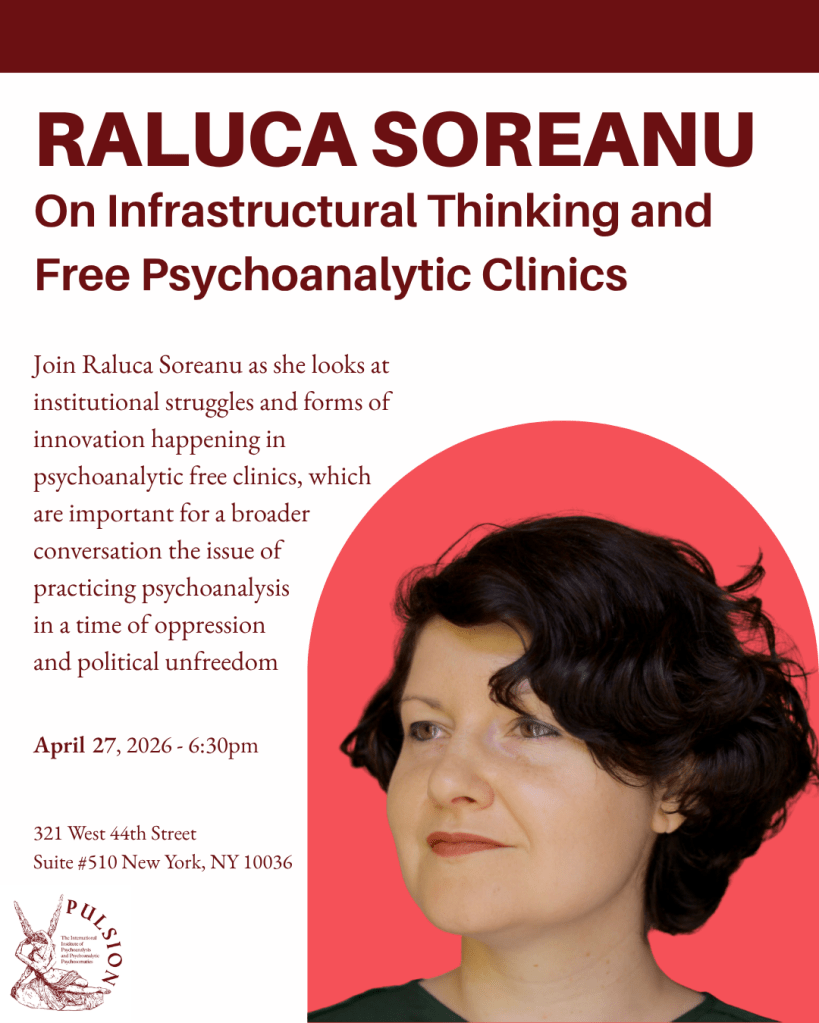
In this talk, Professor Soreanu looks at institutional struggles and forms of innovation happening in psychoanalytic free clinics
Raluca Soreanu examines the institutional struggles and experimental forms of practice that emerged in psychoanalytic free clinics, situating them within a broader inquiry into the boundaries of psychoanalysis—its relation to money and the fee, and the possibility of analytic work under conditions of political oppression and curtailed freedom.
She places in productive juxtaposition two sites and historical moments. The first is the Budapest Polyclinic of the 1930s, among the earliest free clinics, operating at a time when psychoanalysis itself was negotiating its institutional survival. The second is the Social Clinic in Rio de Janeiro, founded by Hélio Pellegrino in collaboration with Katrin Kemper in the early 1970s, at the height of the Brazilian military dictatorship. Conceived as an experimental space, the Rio clinic sought not only to expand access to analytic treatment but to rethink the social bond more broadly, interrogating the limits of psychoanalysis as practiced within mainstream training societies.
Across these disparate contexts, Soreanu traces what she calls the creation of “soft devices”—collective inventions that subtly but decisively reconfigured the analytic frame. These innovations were not merely technical adjustments; they were infrastructural interventions. By comparing the strategies developed in Budapest and Rio, she advances the concept of “infrastructural thinking” to illuminate how these clinics responded to the concentric crises within which psychoanalysis was compelled to operate. In doing so, she reframes questions of resilience and survival as questions of institutional imagination: how psychoanalysis, under pressure, reinvents the very conditions of its possibility.
Raluca Soreanu is a psychoanalytic and psychosocial thinker and writer. She is Professor of Psychoanalytic Studies in the Department of Psychosocial and Psychoanalytic Studies, University of Essex, UK, and a psychoanalyst, member of the Círculo Psicanalítico do Rio de Janeiro, Brazil, and of the Site for Contemporary Psychoanalysis, UK. She is the author of Working-through Collective Wounds: Trauma, Denial, Recognition in the Brazilian Uprising (Palgrave, 2018) and the co-author, with Jenny Willner and Jakob Staberg of Ferenczi Dialogues: On Trauma and Catastrophe (Leuven University Press, 2023).
Her new book The Psychic Life of Fragments: On Splitting and the Experience of Time in Psychoanalysis will be published by Routledge in April 2026 in the Relational Psychoanalysis Series. She is the project lead of the FREEPSY: Free Clinics and a Psychoanalysis for the People: Progressive Histories, Collective Practices, Implications for Our Times (UKRI Frontier Research Grant), an interdisciplinary collective of ten researchers studying the histories and legacies of free psychoanalytic clinics around the world. She is Academic Associate of The Freud Museum London; and Editor of the Studies in the Psychosocial series at Palgrave and of the Important Little Books in Psychoanalysis Series at 1968 Press.
![April 11, 2026 – Free Book Launch Event [Portuguese] – Fanatismo, Negacionismo, Mentira : Estudos Psicanaliticos de Roosevelt Moises Smeke Cassorla](https://psychoanalysisandsocialjustice.com/wp-content/uploads/2026/03/image-11.png?w=685)
![Mental Health Practitioners Against The Amendment To Trans Act / A statement by Mariwala Health Initiative [India]](https://psychoanalysisandsocialjustice.com/wp-content/uploads/2026/03/image-10.png?w=1024)
 Psychoanalysis and Social Justice
Leave a comment