
A year ago, I moved from New York City back to Montevideo, Uruguay, the country where I am originally from. Yet the Montevideo I returned to was not the same city I had left thirteen years earlier, and I, too, was no longer the same person.
One afternoon, while walking through its streets, rediscovering places that felt both familiar and unfamiliar, I found myself thinking of a poem by one of Uruguay’s most beloved poets, Mario Benedetti. (1920–2009), who wrote often about exile and belonging. The poem is entitled “Quiero creer que estoy volviendo” (I want to believe I am returning).
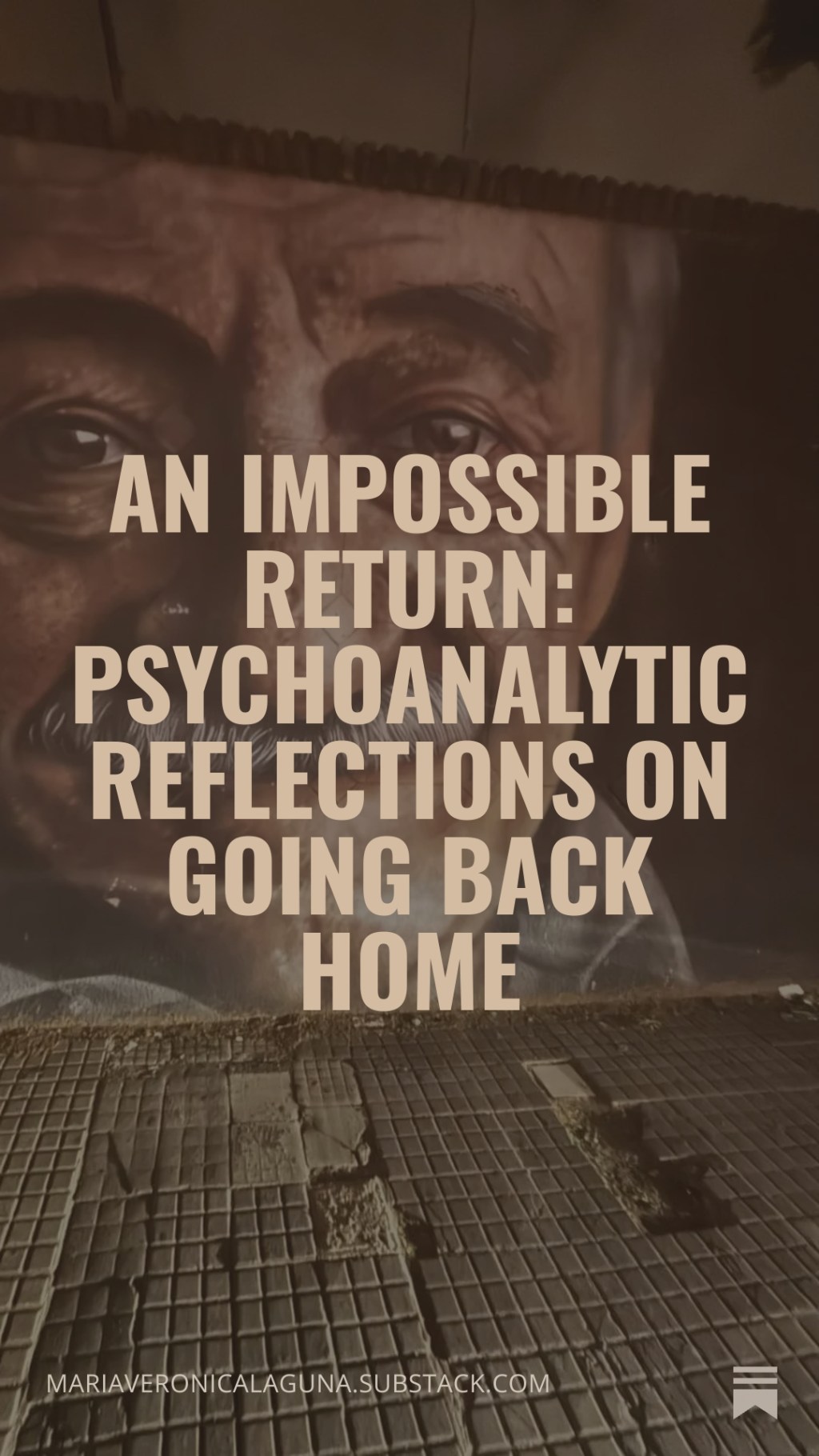
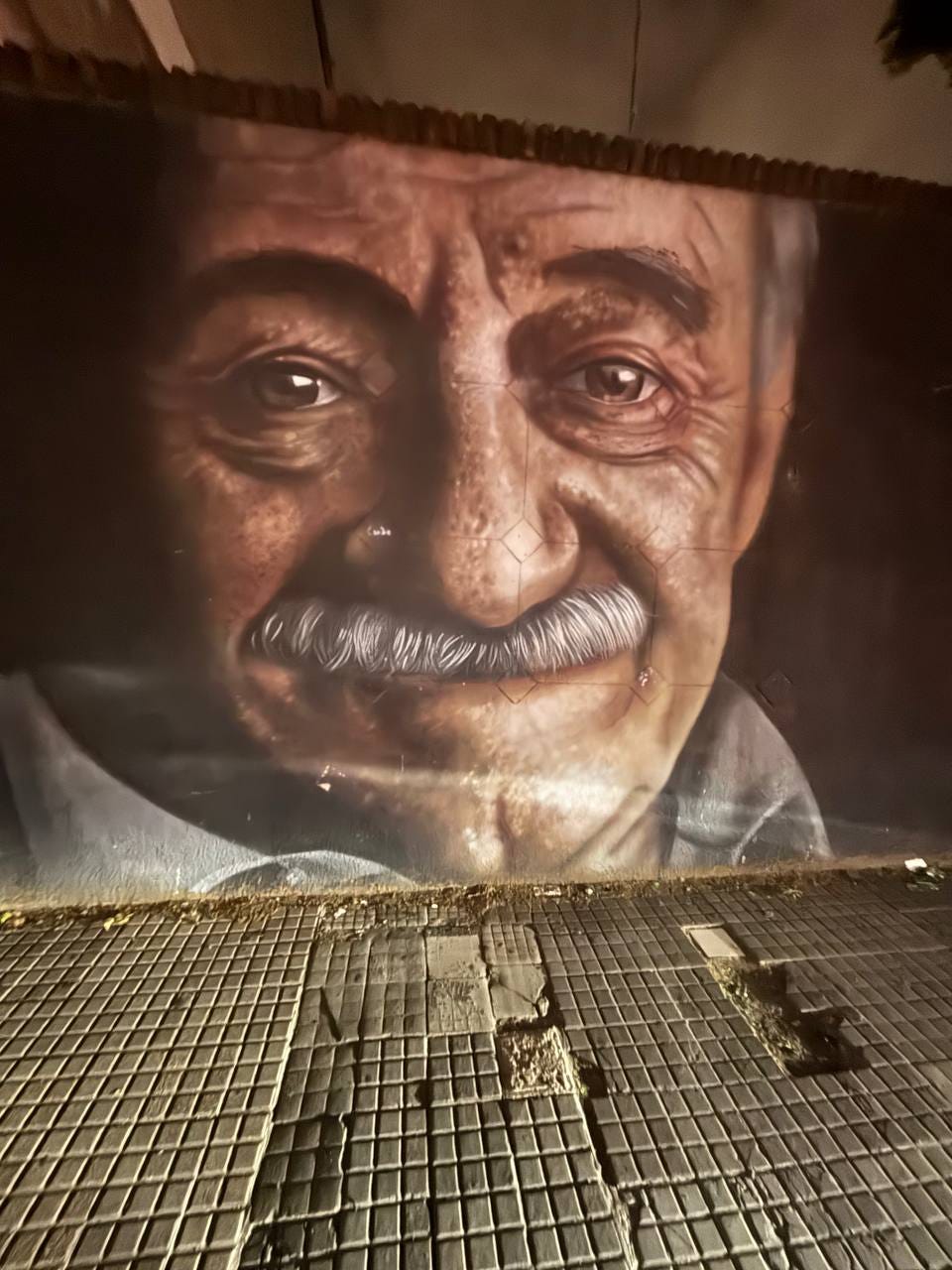
In the midst of my walk, an uncanny moment found me. I bent down to tie my shoelaces, and when I looked up, a mural appeared before me. That sudden encounter carried me instantly back to Benedetti’s poem.
“I return, I want to believe I am returning / with my worst and my best story / I know this road by heart / but still I am surprised…”
This poem made me reflect not only on my own experience of return migration, but also on that of many others -respecially in the United States- who face similar questions of belonging and displacement.
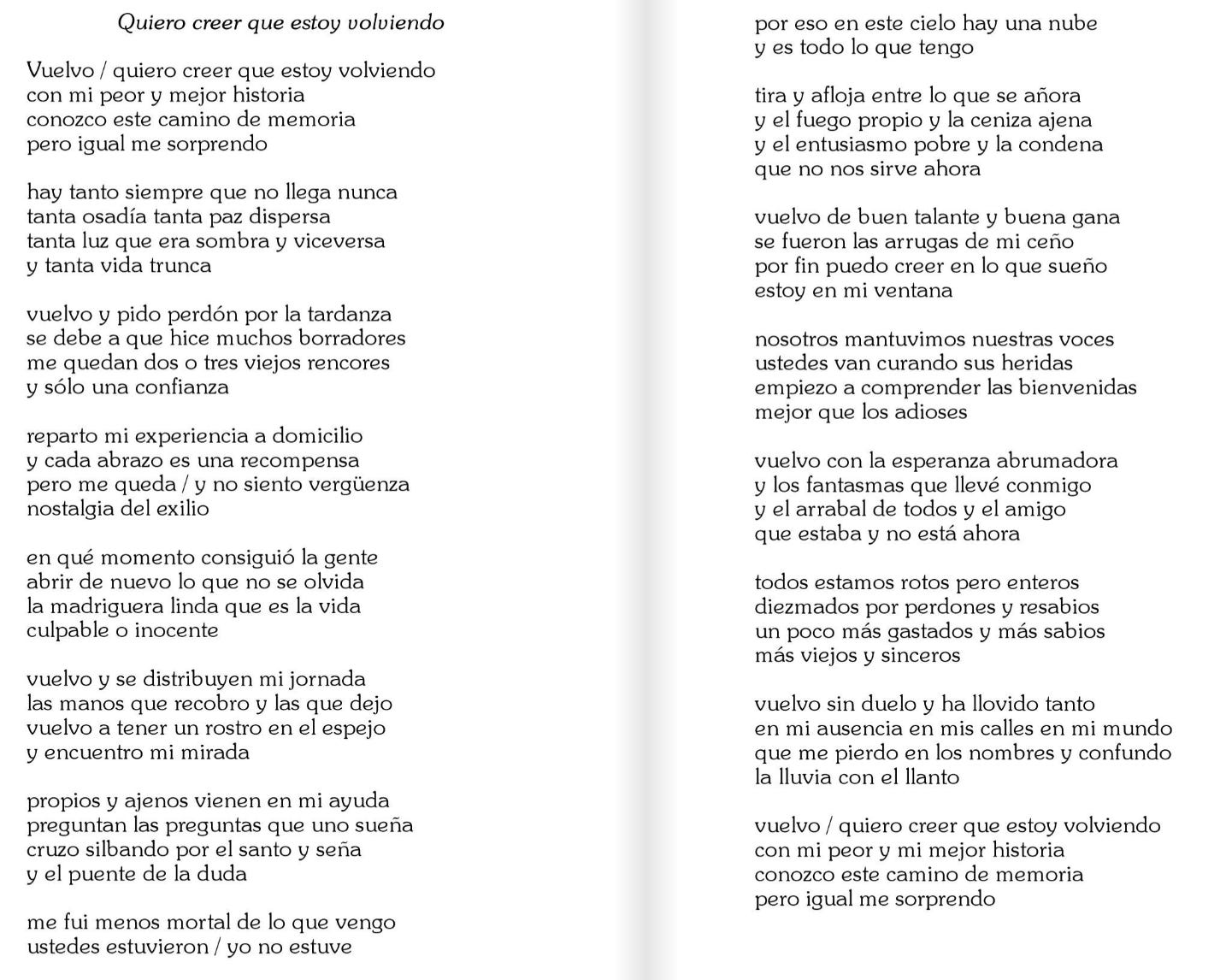
DISCLAIMER: The fragments I will discuss below come from a poem originally written in Spanish. Since I couldn’t find any official English translations, I leaned on my Uruguayan roots and my ESL teaching background to craft my own version. My hope is to open this beautiful piece to other returning migrants who don’t speak Spanish, so they too can feel the beauty and the ache of Benedetti’s words.
I Return, I Want to Believe I Am Returning (Selected Fragments)
I return, I want to believe I am returning
with my worst and my best story
I know this road by heart
but still I am surprised
The returning migrant wants to believe in a situation that at times still feels unreal, even though the road back home is known by heart. What emerges is a paradoxical experience: a combination of familiarity and surprise. The returning migrant reconnects with familiar aspects while simultaneously confronting the new ones that developed during their life in their former country.
There is always so much that never arrives
 so much daring, so much scattered peace
 so much light that was shadow and vice versa
 and so much life cut short
This verse describes the experience of chronic longing so familiar to exiles. Peace is not lived as a continuous thread but as a fragmented, unintegrated experience. “The light that was shadow and vice versa” evokes the integration of split parts: the interplay between what is embraced and what is hidden. Migrating and returning stir up this particular vulnerability: the confrontation with divided aspects of the self and their uneasy coexistence.
Psychoanalysts Vamik Volkan and Salman Akthar have written extensively on the migrant experience, and how the migration process changes one’s relationship with time. Volkan (1999), for example, has written about poisoned nostalgia , where longing for the past becomes toxic, trapping the migrant in an idealized homeland that no longer exists. If someone returns to their country on this mental state, the clash of inner and outer realities may lead to extreme anxiety and profund disillusionment. The role of the analyst, in this case, is to help the patient integrate this new reality while integrating past experiences that had been previously unsymbolized or disavowed.
I return and ask forgiveness for the delay
 it’s because I made many drafts
 I still carry two or three old grudges
 and only one confidence
To ask for forgiveness is to acknowledge guilt, which is such a central part of the migrant experience, and, when left unexamined, it can have a corrosive effect on the person’s ense of self worth and can inhibit growth and life accomplishments. The “grudges carried” may serve another psychic function: they can sustain a connection in the migrant’s mind, keeping alive ties to the past even when physical presence was impossible. In this way, guilt and resentment coexist as paradoxical forms of attachment: expressions of both loss and continuity in the migrant’s inner world.
I deliver my experience door to door
 and every embrace is a reward
 but I still feel -and I say this without shame-
 nostalgia for exile
It is the coexistence of two seemingly contradictory feelings: the warmth of the embrace of loved ones upon returning, and the strange nostalgia for what has been left behind. For a moment, the migrant experiences nostalgia for the very place to which they have just returned. This paradox reveals the multilayered nature of exile: longing is never fully resolved, but shifts its object. What was once nostalgia for the homeland becomes nostalgia for the foreign land, and upon return, nostalgia reappears for the homeland itself, now altered and unfamiliar. This caleidoscopic shift can create moments of disorientation in the returning migrant.
I return and my day is distributed
 among the hands I recover and those I leave
 I return to have a face in the mirror
 and I find my gaze
To return is to be mirrored again by loved ones – those who hold the memory of our past and reflect it back to us. In their presence, we rediscover a face in the mirror, a gaze that feels both familiar and renewed. This mirroring is not only visual but cultural: the shared sense of humor, the codes of language, the gestures and rhythms that belong to a collective memory. It is through these witnesses of our past that fragments of identity are reassembled, allowing the migrant to feel continuity even within the rupture of exile.
What happens when a returning migrant cannot find their own gaze in the reflection of their mother-land? This made me think of the “Still Face” experiment, created by developmental psychologist Edward Tronick, shows how infants react when a caregiver suddenly withdraws emotional responsiveness: babies quickly become distressed, attempt to re-engage, and if ignored, show signs of despair. What happens when the returning migrant hopes to reconnect to a mother-land that is emotionally unresponsive or inconsistent? Or when the mother-land that tries to welcome the returning-migrant/baby but cannot full recognize them?
Moments of misattunement and confusion are intrinsic to the experience of return. Even when the motherland seems to recognize us, our gaze is inevitably filtered through the rupture of separation. Attempting to convey the life lived abroad can feel like an overwhelming task, often accompanied by a sense of solitude and disconnection, which at times can mirror the confusion of that infant who cannot (at least temporarily) find themselves in their mother’s gaze.
A tug-of-war between what is longed for
 and my own fire and another’s ashes
 between poor enthusiasm and condemnation
 that no longer serves us
This fragment captures the ambivalence at the heart of return: the tension between creativity and destruction, separation and division. The migrant is caught in a tug-of-war between longing and disillusionment, an inner struggle that Kleinians may understand with more nuance.
The phrase “that no longer serves us” resonates with the idea of a defense mechanism no longer being as effective to the patient as it used to, prompting them to find new psychic solutions.
I return in good spirit and good will
the wrinkles of my brow are gone
at last I can believe in what I dream
I am at my window
I love how this captures the embodied element of this shift: The bygone wrinkles of his brow speak of time’s passage and its mark on the body: skin stretched by frowning, by the wide-eyed vigilance of fear, by anger, or by surprise. They are the marks of exile, of years lived in tension. To say they are gone is to suggest a release, a softening, a return to a more open gaze.
Believing in a dream signals a shift: what once felt impossible begins to take shape as reality, an imagined reality that does not yet exist. Perhaps Benedetti’s act of writing itself is a way of imagining this reality, rehearsing it first in his mind and via writing, creating a transitional space in which inner and outer realities meet.
We kept our voices
 you are healing your wounds
 I begin to understand the welcomes
 better than the farewells
Welcomes “make sense”: they signify reconnection, sustenance, and the possibility of continuity. They allow the migrant to feel embraced again, to re-enter a network of belonging and social bonds. Farewells, by contrast, resist elaboration and symbolization when the possibility of loss seems unbearable. They are ruptures, often experienced as arbitrary or violent, especially when exile itself was prompted by political persecution or social upheaval, as in Benedetti’s case (and in my case and the case of many patients I work with).
For many returning migrants who endured forced removal, a farewell is itself a privilege. For undocumented immigrants, the thought of a warm “welcome” may remain a distant dream.
I return with overwhelming hope
 and the ghosts I carried with me
 and the neighborhood of everyone and the friend
 who was and is no longer
Benedetti seems fully aware of what he carries in his luggage: the neighborhood, the power of community, and the meaning of family (elements that can vary profoundly across cultures). His words remind us that return is never only about the individual; it is also about the collective spaces and relationships that shape identity. The migrant does not come back alone but brings with them the echoes of community, the memory of shared streets, and the absence of those who are no longer there.
We are all broken but whole
 decimated by forgiveness and remnants
 a little more worn and more wise
 older and more sincere

Broken but whole, like a piece of Kintsugi: the ambivalence surfaces again.
Benedetti’s verse captures this paradox: the migrant returns carrying fractures, but also a renewed sense of wholeness. The experience of exile leaves scars, yet those scars can become sites of wisdom and self-affirmation.
I return without mourning, and it has rained so much
 in my absence, in my streets, in my world
 that I get lost in names and confuse
 the rain with weeping
Did the rain wash away the mourning? Benedetti suggests that absence erases details, that the migrant forgets what was once familiar. Upon returning, he finds himself a stranger to places that should feel like home.
This confusion, mistaking rain for tears, to me, captures this disorientation. It can be seen as a projection of his sadness into the landscape, using the environment as a container of experiencing the uncanny estrangement of finding the familiar altered.
When discussing the process of mourning, Ernst Ticho (1966) describes what he calls a process of “reshaping”, in which the personality is reorganized, and there is a reintegration “reintegration” of the internal world on the basis of the interaction with the new environment”
Benedetti seems to have gone through some degree of reshaping, in carrying “both the worst and the best stories” he can have a multidimensional sense of self, which sustains his ability to hold contradiction without resulting in psychic collapse.
This is one of the main challenges of those of us who returned to their countries, either by choice or by circumstance: to not resort to splitting in order to deny the pain of loss and misattunement, to carry our multiple selves without feeling we need to cut parts of ourselves to fit in, to be seen, respected, and embraced in our complexity.
I think Psychoanalysis is uniquely equipped to bear witness to this liminal process of someone “wanting to believe they are returning”. Psychoanalysts understand that where there is wanting to do something, there is also a force in its opposite direction. The analyst helps the patient hold this suspended state between believing and non-believing, between wanting and not wanting.
There isn’t such a thing as returning: we are no longer the same people we were before migrating, and neither is our country. The return is not a rapprochement, but a confrontation with difference. By traversing the illusion of fusion with an external other, and by embracing difference without fear of engulfment, we become better equipped to believe that there is a home we can always return to: ourselves.
References
Akhtar, S. (1996). “Someday…” and “If only…” fantasies: Pathological optimism and inordinate nostalgia as related forms of idealization. Journal of the American Psychoanalytic Association, 44(3), 723–753.
Grinberg, León & Grinberg, Rebeca (1996). Migración y exilio: estudio psicoanalítico. Madrid: Biblioteca Nueva.
Ticho, E. (1966). The mourning process in psychotherapy. International Journal of Psycho-Analysis, 47(3), 324–330
Volkan, V. D. (1999). Nostalgia as a linking phenomenon. Journal of Applied Psychoanalytic Studies, 1

![April 27 [In-Person Event]On Infrastructural Thinking and Free Psychoanalytic Clinics. Raluca Soreanu.](https://psychoanalysisandsocialjustice.com/wp-content/uploads/2024/04/pulsionlogo.png?w=907)
![April 11, 2026 – Free Book Launch Event [Portuguese] – Fanatismo, Negacionismo, Mentira : Estudos Psicanaliticos de Roosevelt Moises Smeke Cassorla](https://psychoanalysisandsocialjustice.com/wp-content/uploads/2026/03/image-11.png?w=685)
![Mental Health Practitioners Against The Amendment To Trans Act / A statement by Mariwala Health Initiative [India]](https://psychoanalysisandsocialjustice.com/wp-content/uploads/2026/03/image-10.png?w=1024)
 Psychoanalysis and Social Justice
Leave a comment