
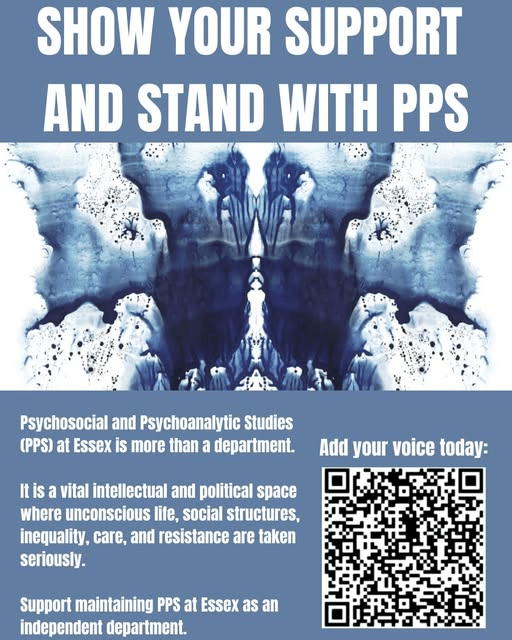
The Department of Psychosocial and Psychoanalytic Studies (PPS) at the University of Essex represents something rare in UK higher education: a thriving, interdisciplinary home for psychoanalysis, psychosocial studies, and critical mental health scholarship at a time when such spaces are disappearing.
The University of Essex is currently undergoing significant restructuring in response to sector-wide financial pressures, including the planned closure of its Southend Campus and a wider programme of redundancies totally 400fte and academic structural reorganisation. As part of this process, proposals affecting departmental structures are under consideration, including changes that could alter the autonomous and independent status of PPS.
Across the sector, many specialist units in this field have been closed, merged, or diluted. With each restructuring, visibility shrinks, recruitment declines, partnerships weaken, and intellectual communities fragment. The long-term result is not efficiency. It is erosion.
PPS stands as proof that another model works. It brings together clinicians, scholars, artists, social scientists, and practitioners around a shared commitment to mental health, the talking therapies, and critical interdisciplinary research. It supports clinical training, world-leading scholarship, international collaboration, and widening participation. It is a visible hub for students, professional associations, and networks seeking serious engagement with psychoanalysis and psychosocial thought.
Its distinct identity is not cosmetic. It is the foundation of its national and international reputation.
Proposals that would dissolve, absorb or merge PPS into a larger disciplinary structure risk weakening one of the few dedicated interdisciplinary centres of its kind in the UK.
Once lost, such spaces are rarely rebuilt. This is not only an internal matter – it is a sector-wide issue. If we believe that psychoanalysis, psychosocial research, and interdisciplinary mental health scholarship have a future in UK universities, then we must say so clearly.
We call on our friends, and allies in professional associations, clinical and therapeutic organisations, academic partners, and our alumni, students, and disciplinary colleagues, to express support for maintaining PPS as an independent psychoanalytic and psychosocial space.
Interdisciplinary intellectual communities do not survive by accident; they survive because people defend them and now is the moment to do so.
Stand with PPS as we fight for the future of psychoanalytic and psychosocial studies in UK HE.
We need your voice – https://forms.gle/AJZVQUHaBSzKW7EV6
If you prefer, please contact Prof Frances Bowen, Vice Chancellor, University of Essex (vc@essex.ac.uk) to show your support for PPS.
![April 11, 2026 – Free Book Launch Event [Portuguese] – Fanatismo, Negacionismo, Mentira : Estudos Psicanaliticos de Roosevelt Moises Smeke Cassorla](https://psychoanalysisandsocialjustice.com/wp-content/uploads/2026/03/image-11.png?w=685)
![Mental Health Practitioners Against The Amendment To Trans Act / A statement by Mariwala Health Initiative [India]](https://psychoanalysisandsocialjustice.com/wp-content/uploads/2026/03/image-10.png?w=1024)

 Psychoanalysis and Social Justice
Leave a comment