

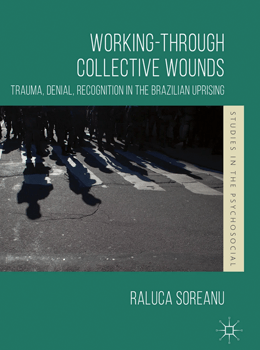
Are crowds capable of mourning or working-through political traumas? What is the psychic work involved in public morning and how can make we make sense of new political symbols that emerge in ample scenes of protest? Drawing on the Brazilian Uprising of 2013 and its aftermath, I write about a semi-spontaneous mourning, a mourning that is not an effect of a state policy, of a planned ceremony, with a designated time and place. It is a mourning that happens when smaller or greater crowds are formed, and when they symbolise together, when they produce rhythms and forms of synchronicity. It is a kind of mourning that occurs through speech, but also through synchronised vocalisations and movements. It is a kind of mourning that occurs though creating symbols, which, are very precise in their connection to the collective wounds left by the years of torture, persecution and silence of an oppressive political regime. I write about a symbolising crowd, capable of complicated constructions, of overlayered references to different historical times, and even of making interpretations. In dialogue with psychoanalytic thinkers such as Sándor Ferenczi and Cornelius Castoriadis, I show that under certain conditions, the street and the square become privileged places for public mourning and working-through, because they enable rhythmic attunement, the return of polysemy and the pleasure of analogy. Ultimately, this is a reconsideration of the grounds of the social bond: can we imagine a social bond that is not grounded in identification, but in rhythmic attunement?
Learning Objectives:
At the end of this presentation participants will be able:
- To critically engage Sigmund Freud’s work on crowds, masses and the social bond.
- To critically engage Sándor Ferenczi’s innovations to the understanding of collective trauma and the social bond.
- To understand how relational psychoanalytic perspectives on attunement and rhythm are relevant to making sense of psychosocial phenomena, e.g. collective mourning.
Raluca Soreanu PhD
Raluca Soreanu is a psychoanalytic and psychosocial thinker and writer. She is Professor of Psychoanalytic Studies in the Department of Psychosocial and Psychoanalytic Studies, University of Essex, and psychoanalyst, member of the Círculo Psicanalítico do Rio de Janeiro. She is the author of Working-through Collective Wounds: Trauma, Denial, Recognition in the Brazilian Uprising (Palgrave, 2018) and the co-author, with Jenny Willner and Jakob Staberg of Ferenczi Dialogues: On Trauma and Catastrophe(Leuven University Press, 2023). At present, Raluca Soreanu is working on a theoretical-clinical monograph, The Psychic Life of Fragments. On Splitting and the Experience of Time in Psychoanalysis. She is the project lead of FREEPSY: Free Clinics and a Psychoanalysis for the People: Progressive Histories, Collective Practices, Implications for Our Times (UKRI Frontier Research Grant); Academic Associate of The Freud Museum London; and Editor of the Studies in the Psychosocial series at Palgrave.



 Psychoanalysis and Social Justice
Leave a comment