

from $10.00
**This course is in-person only. There is no virtual component. Participants must be age 21+
Full Tuition: $320 — Scholarship options are available in the drop-down enrollment menu for you to self-select.
Instructor: Lindsey Andrews | 5-weeks | Wednesdays September 11 – October 9 | 7:00 – 9:00 PM ET | In-Person, Durham, NC
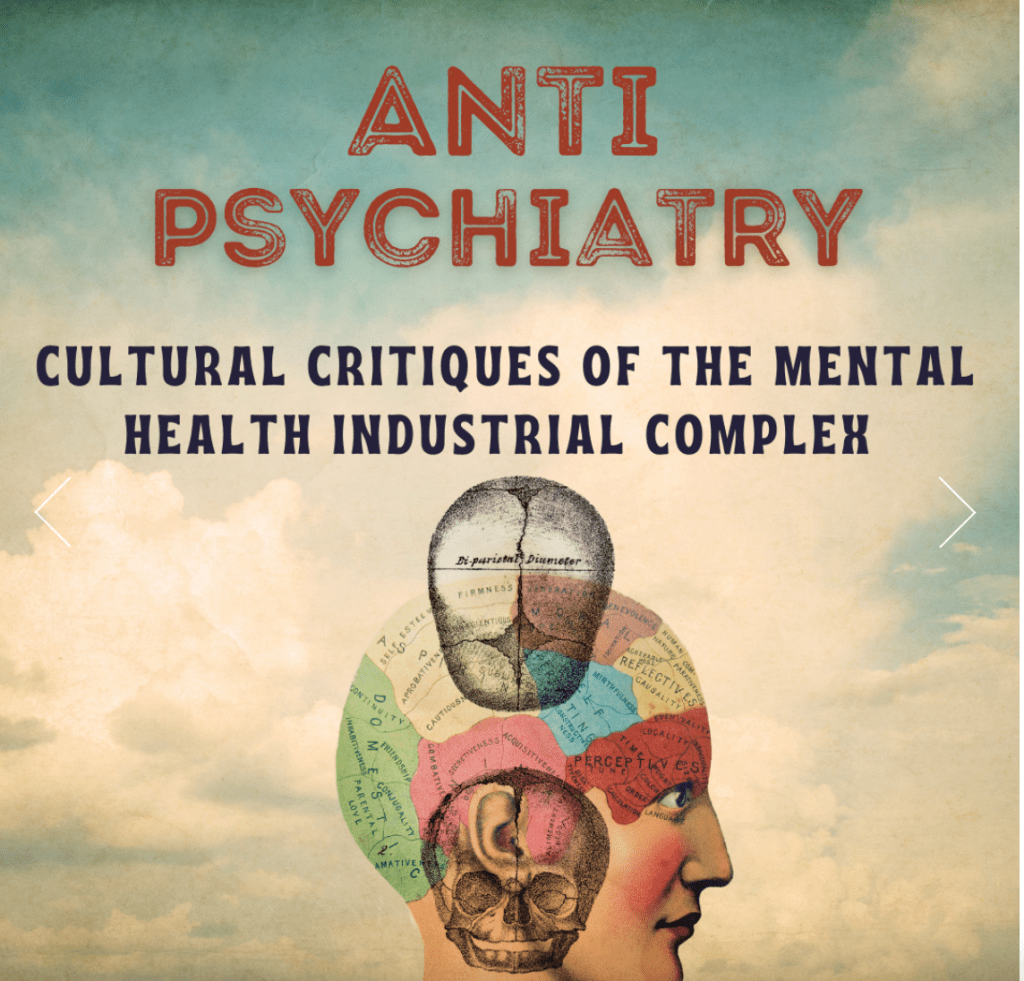
What are the root causes of mental illness, and who benefits from our collective mental distress? As Mark Fisher writes in Capitalist Realism, “It goes without saying that all mental illnesses are neurologically instantiated, but this says nothing about their causation.” For Fisher, “this requires a social and political explanation; and the task of repoliticizing mental illness is an urgent one.” Today, mental health is a global industry that transmits US diagnostic and treatment practices across the world while reaping billions of dollars in pharmaceutical profits. More people than ever report psychic distress, but it is treated as an individual problem to be solved via self-help, therapy, drugs, and consumerism. Certainly, diagnosis, medication, and various therapies offer relief for many, but nevertheless, numerous practitioners, theorists, and patients have argued that the mental health industry misses the forest for the trees, since our social and economic systems clearly contribute to this suffering. Over the course of five weeks, we’ll explore social and political critiques of the global mental health industry. We’ll begin by reading the foundational arguments of the Anti-Psychiatry Movement of the 1960s and ‘70s, by authors such as Michel Foucault and R.D. Laing, who rejected the privatizing practices of both psychoanalysis and biomedical psychiatry. We’ll explore alternative approaches, such as Social Psychiatry practiced at the LaFargue Clinic in Harlem and the “schizoanalysis” of Felix Guattari and Gilles Deleuze. And we’ll follow along with contemporary sociologists and psychotherapists who explore the imbrications of psychology and psychiatry with global capitalism and the military-prison-industrial complex, while also imagining alternative social and political approaches to mental health. In addition to the authors mentioned above, we might explore works by authors such as Lynne Haney, Naomi Klein, Frederic Wertham, Ethan Watters, and Stefania Pandolfo.
—
This class will take place in person at Night School Bar in Durham. Night School requires that students refrain from attending in-person classes when sick. For more on our class policies, see our FAQ. Instructors will also follow this policy. If your instructor is sick, class may be moved to online for a session or rescheduled to the week following the final scheduled session at the instructor’s discretion.
Sliding Scale: Night School Bar pays instructors and staff a living wage, and your tuition goes toward supporting this practice. Please pick the payment tier that corresponds to your needs, and consider our commitment to fair labor practices when doing so. We will never request or require proof of need, and do not use an income-based sliding scale; we trust you to decide what payment tier is right for you. If you would like additional support deciding or would like to learn more about the practice of using a sliding scale, we recommendthis resource from Embracing Equity.
Scholarships: We are currently able to offer three full scholarships per class. Our full scholarship tier is a nonrefundable offering, limited to one per student per month. Because our scholarship funding is limited, selecting multiple full scholarships in a single month will result in disenrollment from all classes. If the scholarship tier you need is sold out please email us directly, and we will add you to a waitlist and notify you if additional scholarships become available. Please see our FAQ for more information, including installment plans and refund policy.
 Psychoanalysis and Social Justice
Leave a comment