
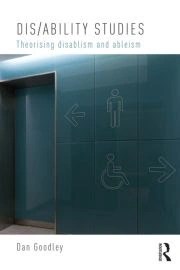
Book review obtained here, to get the book visit this link
Dan Goodley is a prolific disability studies scholar and Dis/Ability Studies: Theorising Disablism and Ableism emerges out of 20 years of collaborative research in this interdisciplinary field. The book begins with the following key questions:
What will humanity look like in 20 years when more and more people are being labelled as disabled? How might it be helpful to think through the ways in which disability and ability are co-constituted? How can activists, researchers, allies and practitioners associated with what we might loosely define as the disability field address the contemporary concerns facing disabled and non-disabled people in a time of austerity? To what extent does an analysis of disability immediately require one to scrutinize ability? (ix)
To examine these questions, Dis/Ability Studies maps, analyses and critically challenges multiple process of disablism, defined by Goodley as ‘the social, political, cultural and psycho-emotional exclusion of people with physical, sensory and/or cognitive impairments’ and ableism understood as ‘the contemporary ideals on which the able, autonomous, productive citizen is modelled’ (Goodley 2014). Dis/Ability Studies is split into two sections: ‘Finding Dis/ability Studies’ and ‘Exemplifying dis/ability studies’. In the first section Goodley lays the ground for ‘dis/ability’ studies as a distinct theoretical project, and in the second he illustrates the ways in which his theoretical project might be realised through research and activist scholarship. Despite the shift to empirical research in the second section, the overarching project is to reconceptualise dis/ability and in doing so to create new conceptual tools for disability studies in a social and political context where many disabled people are seeing rights eroded under neoliberal regimes. As Goodley notes: ‘We are entering a time of dis/ability studies, when both categories of disability and ability require expanding upon as a response to the global politics of neoliberalism’ (ix). This is a historical period which the geographer Jamie Peck has described as undergoing a transition from ‘welfare’ to ‘postwelfare’ states in the Global North (Peck 1998, 62). This transition is having a having significant impact on the lives of disabled people evidenced in the current ‘relentless onslaught of attacks’ on welfare provision, stigmatising depictions of people with disabilities as ‘victims’ and a ‘burden’ upon society and a rise in disability hate crimes. What Goodley rightly identifies is that in this context disability studies urgently needs to attend to the disabling effects of neoliberalism itself.
To respond to these conditions, Goodley spends the first four chapters surveying the history of theoretical debates in disability studies and wider social theory, to argue that we need to think again about the co-constitution of dis/ability. Disability theory, as Goodley argues, should be concerned with developing understandings of disability as a ‘sociological, economic and cultural’ process rather than ‘a psychological, embodied or medicalised problem’ (3). This perspective is one that refuses essentialist understandings of disability, even whilst disability politics might simultaneously need to fight for rights armed with medical or other categorical understandings of impairment. This post-structuralist approach is critical for Goodley because, as he argues, if disability studies focuses solely on impairments, or indeed on categories of disability, then it risks mystifying the conditions under which disability is produced in specific historically situated geo-political spaces. As he notes:
When disabled people become solely objects of study, are reduced to fetishized products of professional or academic knowledge, are fixed as untroubled entities, are conceptualised only as social actors caught up in processes of oppression, then we risk limiting not only the lives of individuals fixed in this gaze but also the possibilities of the study of dis/ability. (xii)
Disablism is conceived by Goodley, then, as forms of practice and experience which ‘exclude, eradicate and neutralise those individuals, bodies and minds and community practices that fail to fit the capitalist imperative’ (xi). It is therefore impossible to theorise disablism without also interrogating ableism, which ‘breeds paranoia, confusion, fear and inadequacy’ (xi). Dis/Ability Studies insists on keeping disability and ability in continual dialogue in order to explore their co-construction: ‘stalking ableism while contesting disablism’ (Campbell 2009).
The first four chapters offer the theoretical grounds with which we might examine the ways in which conditions of neoliberal disenfranchisement are producing new kinds of dis/abled subjects, and how we might research and contest this. In Chapter Five, Goodley brings his theoretical revisioning of dis/ability to bear on empirical research, by detailing how the co-constitution of dis/ableism might work to understand research findings. Introducing five research projects, he illustrates the critical importance of a theoretical informed approach to disability research that situates experience within a broader social and economic frame of analysis. These research vignettes offer concrete examples of dis/ability as a productive orientation for disability researchers. Chapter Six, ‘Precarious Bodies’, focuses on what he describes as ‘the epidemic of disability diagnoses’, drawing on interviews of parents of infants and children diagnosed as disabled, and the losses and gains of the medical categorisations. Chapter Seven focuses on the ways in which disability limits and shapes access to schooling, and in particular how neoliberal forms of education (with emphasis on targets, performance and competition) undermine the possibility of diverse, relational educational communities. Chapter Eight returns to ableism, playfully employing a dis/ability lens to critique ‘cultural normalism’. As Goodley illustrates, the disabled Other is caught ‘in the violent maintenance of the normative order’ (129) eliciting anxious, fascinated or aversive responses that are exhausting to live. At the same time, these experiences mean that disabled people are uniquely positioned as critical theorists of normative culture, who together have an immense pool of knowledge, resource and experience with which to trouble prevailing forms of ‘common-sense’. Chapter Nine adds depth to Goodley’s understanding of the ways in which neoliberalism produces new forms and figures of disability. Moving through examples such as the Paralympics, the Oscar Pistorius case, welfare reform and the figure of the benefits scrounger, this chapter produces a rich account of how neoliberal ideologies create ideal and abject subjectivities which resonate with the demands of market capitalism. At the same time, Goodley details the individualistic demands of neoliberalism; detailing, for example, how the punishing effects of welfare reform generates resistance from below. In the concluding chapter, Goodley turns to Hardt and Negri’s concept of ‘the multitude’ to think through how dis/ability studies might be open to wider process of global disenfranchisement: ‘we urgently require sophisticated critical theories of ableism and forms of activism that draw in allies and alliances with other subjected to the forces of neoliberal-ableism’ (34).
Dis/Ability Studies brings together a dizzying array of new theoretical concepts, tools and lenses with which to activate a dis/ability imagination. What makes Dis/Ability Studies an exciting read is the incredible volume of theory and empirical research that Goodley reviews, synthesis, dissects and analyses. As an attempt to forge a new way forward for disability theory, Dis/ability Studies will undoubtedly led readers to new critical recourses, as they follow up Goodley’s references and learn more about the potential of employing ‘crip theory’, ‘cruel optimism’, ‘debility’, and so forth as critical tool of analysis.
Dis/Ability Studies is also a hopeful book of deep ethical and political conviction that insists we learn from ‘disability communities’ to create alternatives to the imperatives of market capitalism, forms of living which emphasise interdependence not independence, collective support not individualised autonomy. In the final instance, disability is reconceived as an opportunity for reimagining the lives we all lead.

 Psychoanalysis and Social Justice
Leave a comment